
What “On Track” Actually Looks Like: Realistic Timelines for Post-Acquisition Data Migration
Plenty of enterprise data migrations get declared a success at go-live, only to be quietly admitted as failures six months later.
The cutover banner goes up, the integration team disbands, and everyone celebrates. Then reality sets in. Financial reports fail to reconcile, business units lose trust in the records, and teams quietly build offline shadow spreadsheets just to keep daily operations moving.
Data migration success is not a go-live date. It is a condition that must be defined, measured, and sustained.
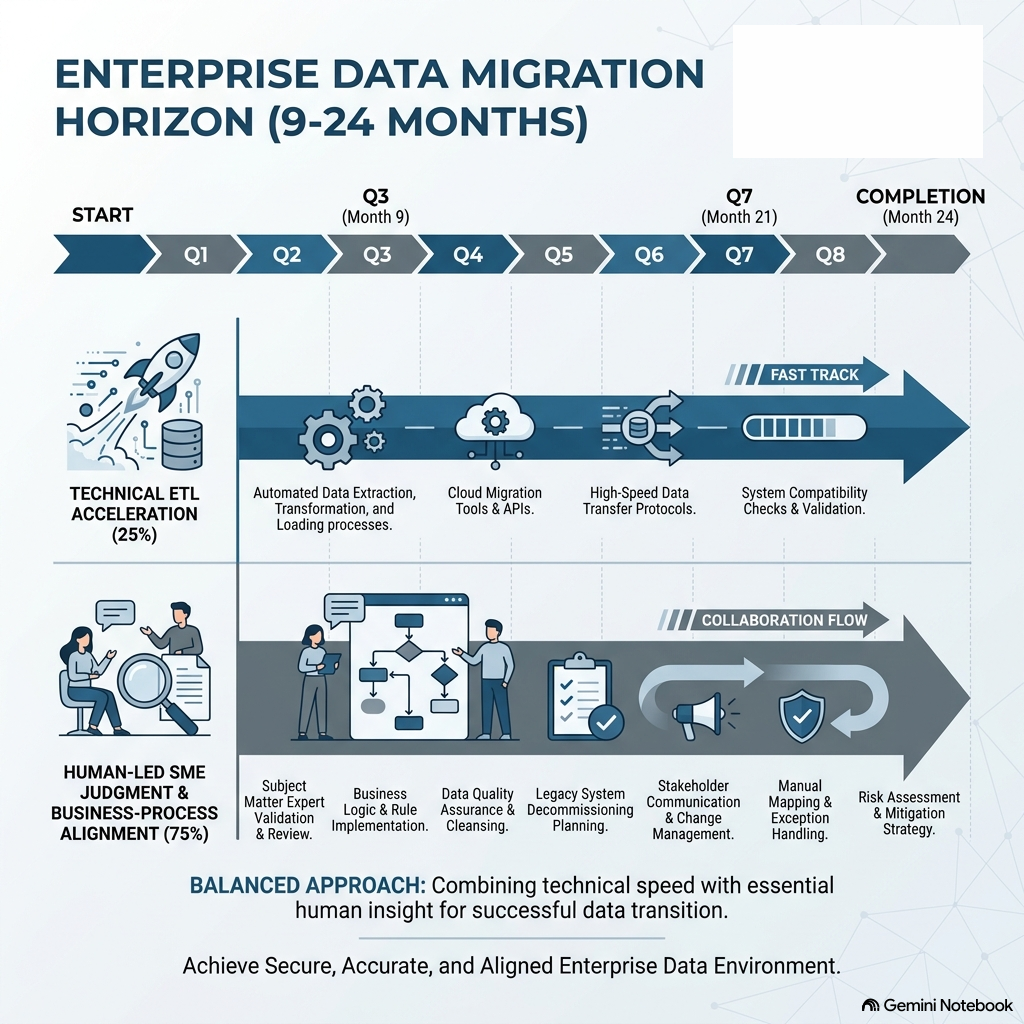
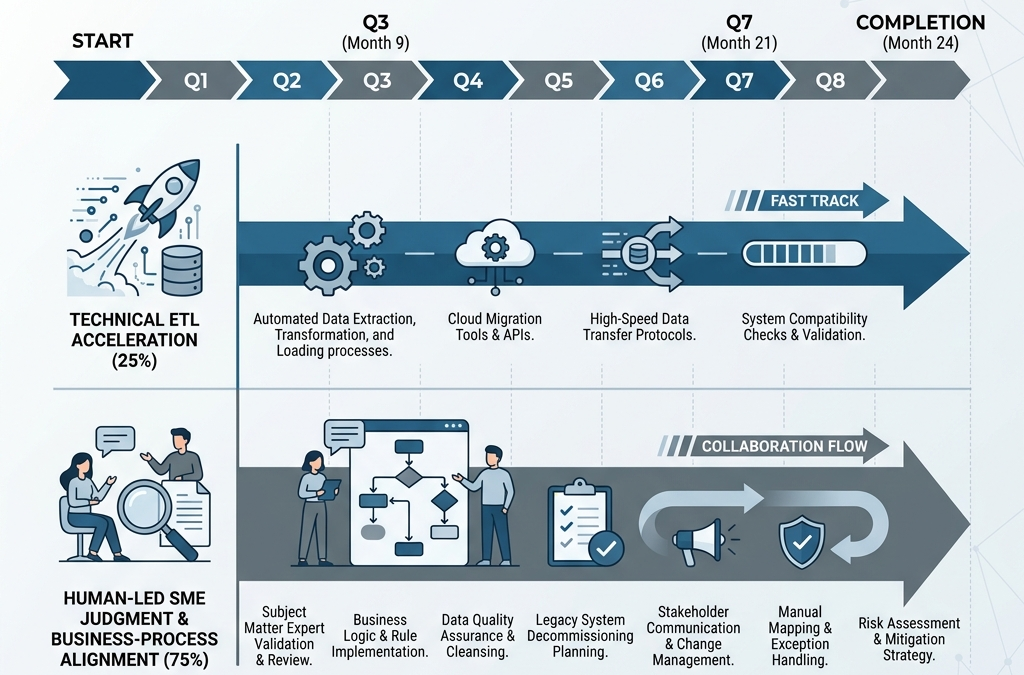
Here is what realistic project horizons look like for migrations of real consequence: nine months minimum for focused integrations covering a single core domain, eighteen months for standard enterprise multi-system consolidations, and twenty-four months or more for complex global acquisitions or joint ventures. None of these timelines are outliers. They represent the normal operational range.
Why does it take this long? Because technical ETL work, meaning extracting, transforming, and loading data, is the smallest slice of the project calendar. The work that actually consumes the timeline is human-led: subject matter expert engagement, business-process alignment, semantic gap reconciliation, and structured UAT review.
AI tools provide genuine acceleration for technical staging, schema profiling, and gap analysis. However, AI does not touch the two-thirds to three-quarters of the timeline driven by SME judgment and cross-departmental alignment. Assuming AI will collapse an eighteen-month migration into ninety days is its own flavor of timeline fantasy.
What “on track” actually looks like, phase by phase: scoping means a signed-off scope backed by automated schema profiling. Remediation means a fully resourced cleanup backlog with assigned SME owners. Architecture means reviewed transformation rules and agreed-upon business logic. Trial migrations should show measurably shrinking gap counts across successive passes. Cutover requires a dual-track go/no-go sign-off covering both technical validation and operational UAT.
Measuring success after cutover requires looking at hard operational baselines: the parallel system licensing costs eliminated, whether business units actively trust and use the new system, and the long-term efficiency of operating one unified technology estate instead of two.
How does your team define data migration success after cutover?
Originally posted on LinkedIn.